

ALM Summit 2025 – Structure for What’s to Come
This year’s SAP ALM Summit EMEA focused on adoption and responsibility. One thing became clear in Darmstadt: The technical foundations have been laid – over 12,000 Cloud ALM tenants are already in use.
But the real question is: How many of them are actually being used and used correctly?
There may still be a long road between deployment and tangible value. Many companies have activated Cloud ALM, but haven’t truly integrated it. The result: data silos instead of transparency, activity instead of control.
This is precisely where it will be decided whether Cloud ALM delivers as a platform – or fizzles out as just another tool.
Cloud ALM as Orchestrator
SAP positions Cloud ALM as the core of an integrated toolchain from scoping to operations.
Not as an additional tool, but as the unifying layer between strategy, execution, and stability.
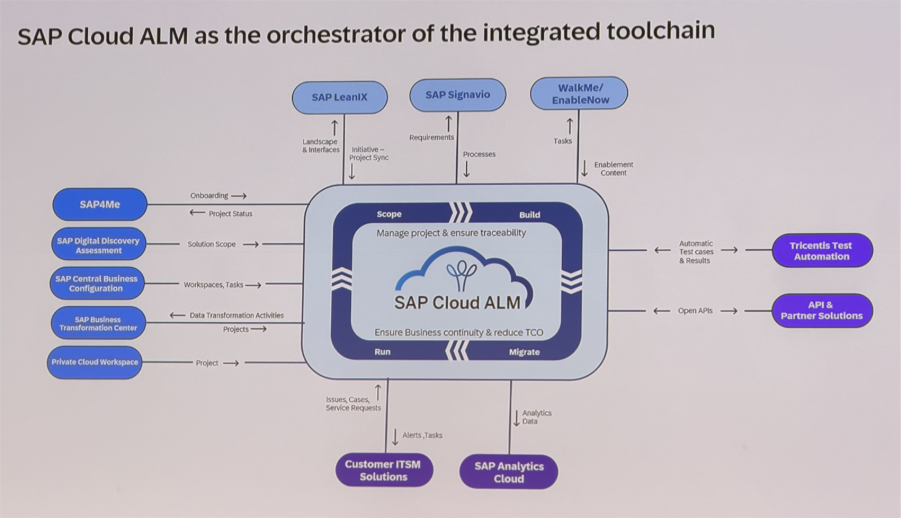
(Foto: SAP Cloud ALM – Orchestrator of the integrated toolchain)
The slides in Darmstadt impressively demonstrated how closely Cloud ALM is now integrated with the entire SAP landscape:
- SAP4Me provides status and onboarding data
- Central Business Configuration defines structures and tasks
- Signavio adds process context
- Tricentis Test Automation enhances quality assurance
- and partner solutions are integrated via open APIs
This creates a landscape where project, operations, and quality don’t exist side by side, but work together. Cloud ALM doesn’t just manage tasks, it orchestrates dependencies and ensures traceability across the entire lifecycle.
The direction is clear: moving away from isolated rollouts toward an orchestrated way of working which is then structured, integrated, and traceable.
Clean Core as Prerequisite
Clean Core was one of the central topics of the summit. Not as a question of architecture, but as a response to three concrete challenges:
Business Change
Companies operate in an environment that is constantly changing, driven by new customer demands, supply chains, and work models.
Only those who keep their systems flexible and close to standard can respond to these changes without having to start from scratch each time.
New Technologies
Innovation today happens in short cycles.
To benefit from this, systems must remain open to new technologies, whether for automation, integration or the usage of AI.
A clean core is the prerequisite for adopting these innovations safely and quickly.
Landscape Complexity
The more systems, interfaces, and variants are involved, the greater the dependency becomes.
Clean Core reduces this complexity by simplifying structures and making changes manageable.
At the same time, Clean Core is the foundation for becoming Public (!) Cloud ready in the long term.
Because standardization and a clear extension logic are prerequisites for adopting future operating models without having to migrate again.
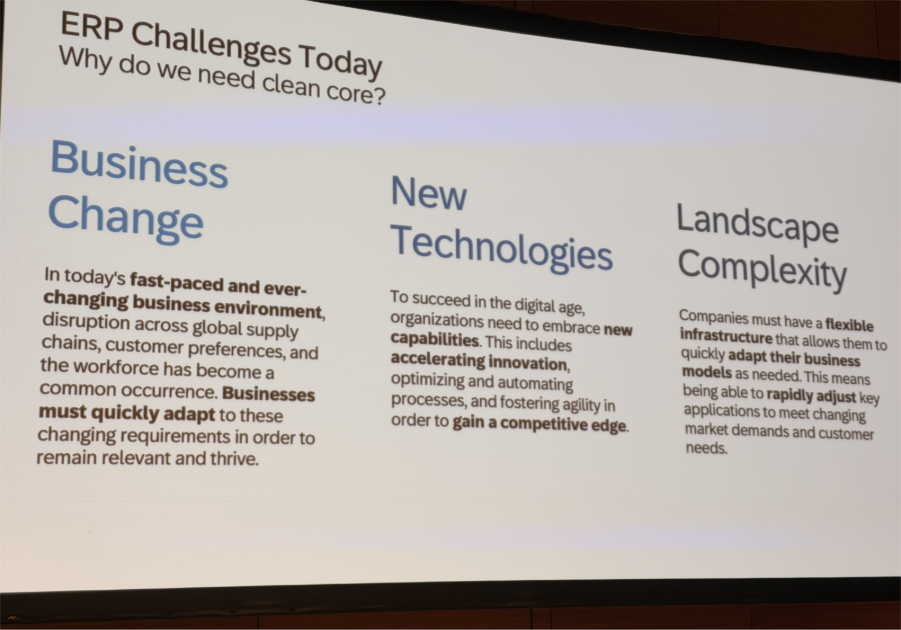
(Foto: Clean Core Slide / „ERP Challenges Today“)
Change and Deployment Management Matures
CDM in Cloud ALM is evolving rapidly, not in theory, but along a clear roadmap.
By H2 2026, the solution is expected to be on par with Solution Manager. Both functionally and conceptually.
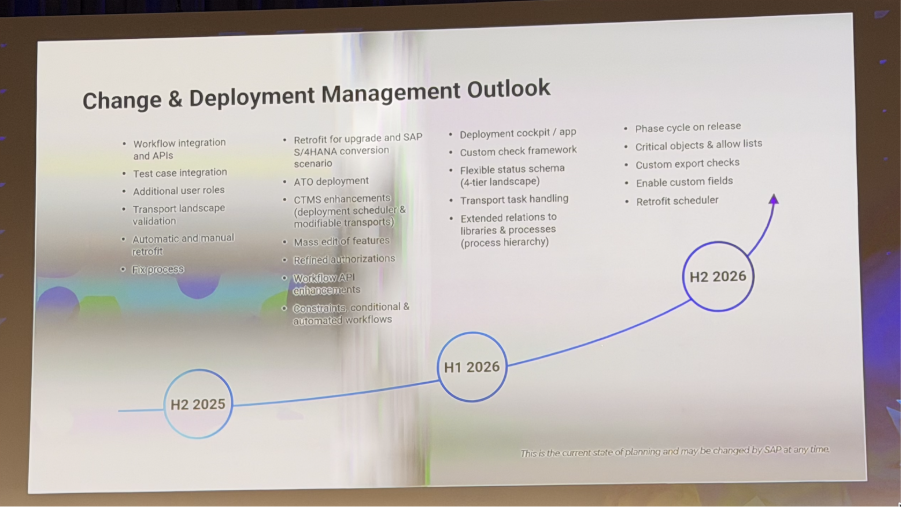
(Foto: Change & Deployment Management Outlook)
The scope is already expanding significantly:
New roles and APIs, test case integration, transport landscape validation, and automatic retrofit are laying the foundation for end-to-end processes.
In 2025, scenarios for S/4HANA conversion, mass edit of features and ATO deployment will follow, making CDM relevant for complex customer landscapes.
In 2026, the features that have so far set Solution Manager apart will follow:
Deployment Cockpit, Custom Check Framework, flexible four-system landscapes, more granular authorizations, and extended process relationships.
This will make Cloud ALM a tool in change management that combines governance, automation, and transparency.
But the same applies here:
Technical maturity is only part of the equation. Real value is only created when companies adapt their processes, roles, and approval workflows to this new logic and its possibilities.
AI as a Tool – Not a Promise
AI was also present in Darmstadt, but less as hype and more as a clearly defined development path.
SAP outlines the path in three stages:
Embedded AI – specific use cases within individual functions: automatic anomaly detection, ticket analysis, or test suggestions.
- They provide immediate relief to teams and create transparency in day-to-day operations.
Conversational ALM – enabled by Joule.
- This enables dialogue with the system: queries, analyses, and controls in natural language.
- The goal: less navigation, more understanding.
Autonomous ALM – driven by agents.
- In this phase, intelligent assistants independently take over recurring tasks – based on rules, context, and experience.
- Human responsibility remains, but it shifts from doing to deciding.
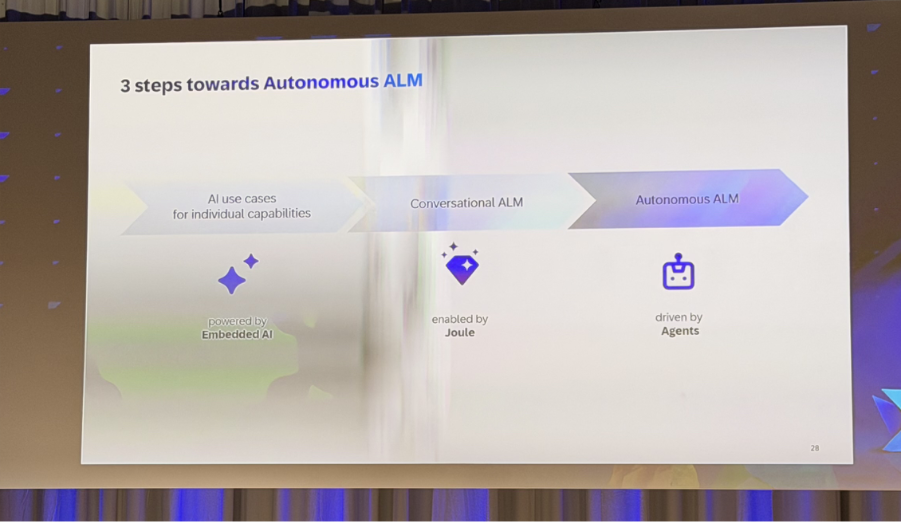
(Foto: 3 Steps towards Autonomous ALM)
This makes it clear: Autonomous ALM is not a leap, but a transition. Step by step, from analysis to assistance, from assistance to autonomy.
Our Conclusion
The ALM Summit 2025 was not a future congress, but a reality check.
The platform is here. The features are here. What matters now is usage – consistent, integrated, and traceable.
Those who truly want to understand Cloud ALM must live it. With clear methodology, governance, and responsibility.
Because value is not created through deployment, but through application.
The best starting point? An honest overview with our alm360 assessment.
We bring structure to projects and clarity to complex systems.
Because only those who know their course will reach their destination 🏁 .
