

Flexibles Change Management with SAP Cloud ALM
How to get started – step by step and with a clear focus
New requirements from the business, legal adjustments, technological innovations – all of this is daily business and has an impact on SAP landscapes.
This makes it all the more important to have change management that does not “paralyze”, but rather supports, guides and ultimately creates freedom again. However, the question often arises when starting out:
How much structure is enough? And how much freedom is allowed?
The answer is: it depends – on the maturity level of your organization, the governance requirements and the system landscape.
If done correctly, SAP Cloud ALM offers a flexible but clear model for this: change management with increasing maturity. It allows you to start lean – and scale up in a targeted manner when complexity or compliance requirements increase.
Our experience at blue.works
We have already implemented different variants in practice – from super lean to fully integrated. And our clear insight:
There is no right or wrong – only “What suits the organization?”
Because every organization is set up differently:
- Some teams need quick implementation without a lot of bureaucracy.
- Others need clear approval channels and complete ITSM processes.
Our task: to develop the right setup together – pragmatic, efficient and capable of growth.
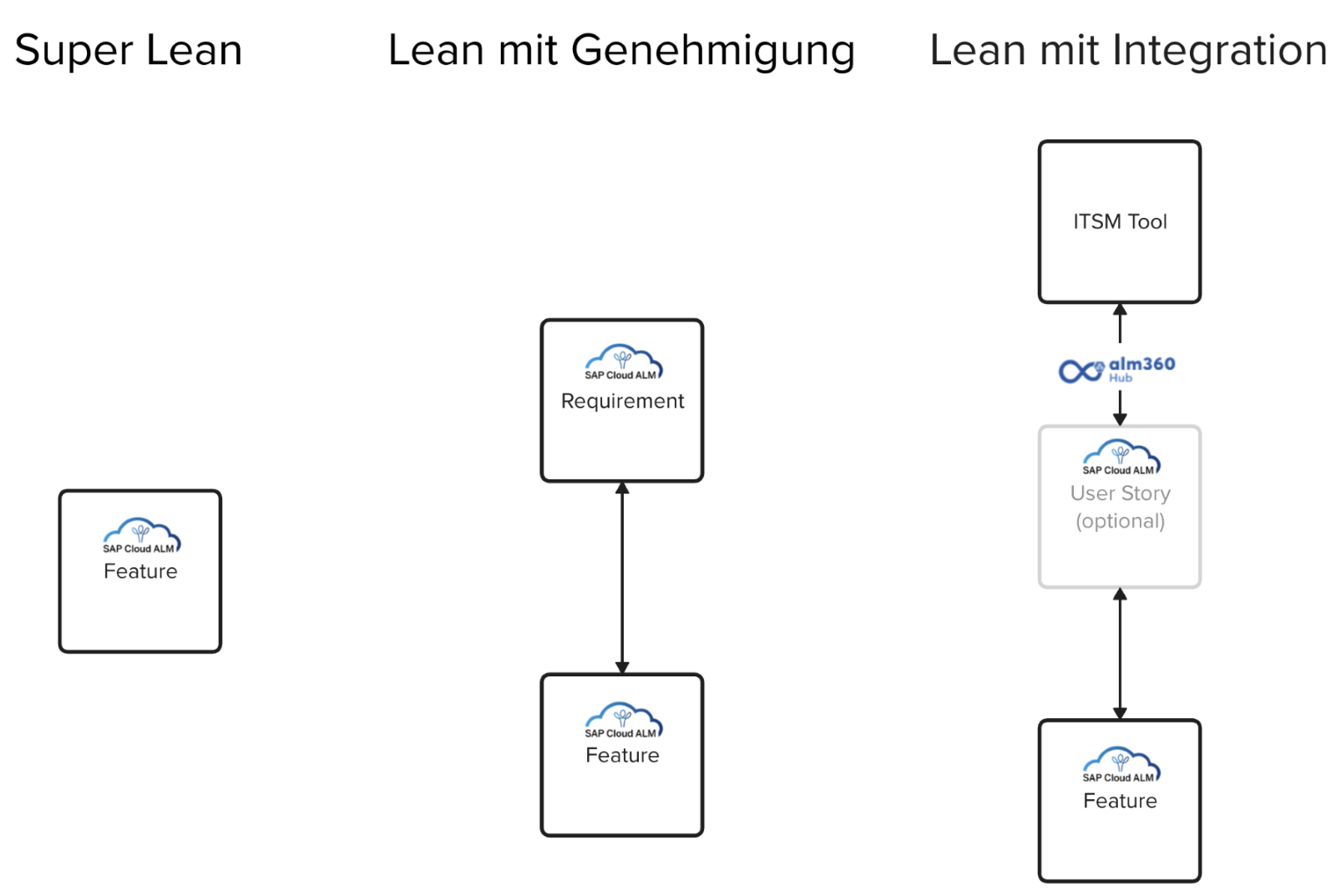
Feature-controlled start – “Super Lean”
Minimum effort, maximum effect.
This variant has a clear focus on teams that want to start quickly but do not want to compromise on traceability and efficiency.
How it works:
The “feature” object is at the center. This is controlled by defined statuses (“In test”, “Successfully tested”, “Ready for production”, etc.) and forms the basis for change verifications. Approvals or other control elements are partially omitted. Why “in part”? Quite simply, the feature in SAP Cloud ALM already provides a good status flow. In the future, it will also be possible to attach a test case to the feature and work with additional roles (developers, testers). If this is not enough, an external workflow engine can also be connected.
Advantages:
- Good Workflow
- Reduction of unnecessary permits
- Transparent implementation and simple test verification (later also via test case)
Restrictions:
- No integration in incident or test case management (planned)
- Traceability is made more difficult for more complex projects
- No automatic link to ITSM processes
Recommendation: For organizations that want to get started pragmatically – without investing time in oversized processes.
Requirement-driven expansion – “Lean with approval”
More structure – without losing mobility.
This is where the request becomes the central control instance. It serves as the basis for approvals and can bundle several features. The request is therefore something like a “change request”.
What it brings:
- Simple extension of the change process if initial guidelines, approvals or internal specifications are to take effect
- Linking test cases directly in the request
- Possibility to group features with a common goal
Advantages:
- Increased degree of control
- Better transparency for larger projects
- More security for quality-critical changes
Restrictions:
- Not yet a complete incident process
- Depending on the governance, maintenance can become more complex
- The “naming” does not fit quite so well (“requirement” instead of “change request”).
Recommendation: For organizations with moderate compliance requirements that want to enable controlled freedom.
Fully integrated – “Lean with ITSM integration”
When all systems talk – and you keep track of everything.
In this variant, SAP Cloud ALM is integrated into an existing ITSM tool – e.g. via the blue.works alm360 Hub, which, thanks to its flexible architecture, can integrate any ITSM tool that offers an external interface (API). This creates a seamless process from incident to change and deployment management. This is an important step towards the “Business Transformation Suite”.
What this makes possible:
- Classic change process including approvals, documentation and traceability
- Clear assignment of incidents to transports
- Consistent end-to-end transparency
Advantages:
- Optimal governance for complex environments
- Central control across all tools
- Traceability and compliance ensured throughout
Restrictions:
- Technical integration required
- Higher initial outlay, but sustainable benefits
Recommendation: For companies that want to set up their entire IT transformation strategically and do not want to take any risks in terms of quality and control.
Conclusion: Start smart. Scale with clarity.
Every change needs structure – but not every structure has to be complicated. The big advantage of the SAP Cloud ALM approach is that you can start where you are today.
Whether you are a small, agile feature team or manage complex corporate IT: with the right setup, you not only achieve clean go-lives – you also create the basis for:
- Efficiency in implementation
- Transparency across all levels
- Trust between business, IT and external partners
Want to know which model suits your setup? We accompany you from the idea to implementation – tried and tested, based on partnership and goal-oriented.
